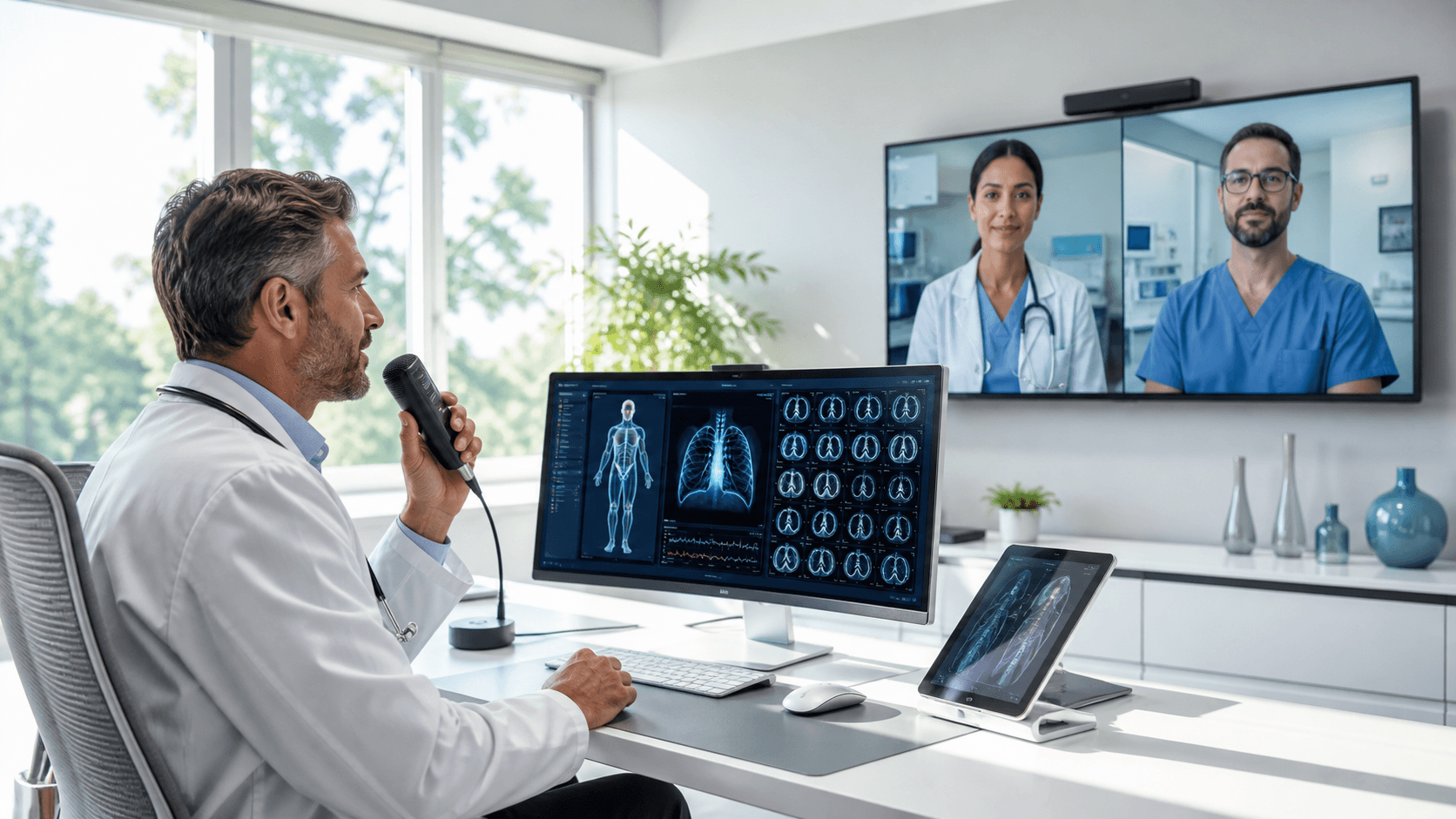
Real-time dictation in specialty clinics is not just about talking instead of typing. It is about keeping notes current so the work does not pile up, visits do not get delayed, and no one is finishing charts in bed at night. When cardiology, ortho, oncology, neurology, and other specialty teams use clear handoff, review, and sign-off models, real-time dictation software for specialty clinics becomes the engine for smoother days, not extra noise.
In this article, we walk through why specialty clinics struggle with note backlogs, what makes real-time dictation actually work, and how MD, APP, and MA teams can share the load in a smart way. We will also cover how to plug Dragon Medical One into common EHRs without chaos and what to measure so you know your new workflow is paying off.
Why Specialty Clinics Struggle with Note Backlogs
Specialty notes are heavy. It is not just a quick cough and cold visit. Many patients have long problem lists, high acuity, and complex care plans that stretch across years. That means more detailed histories, multi-modality diagnostics, and procedure details that must be precise and clear.
Daily clinic life adds even more weight:
- High visit volume with back-to-back slots
- Add-on visits squeezed into already full schedules
- Compressed templates around seasonal peaks like flu or respiratory season
- Jumping between clinic notes, imaging, infusion, and procedure modules
When the day runs long, documentation often gets pushed to the side. Providers end up finishing notes late at night, working from memory. That can raise the risk of errors or missing content. Coding and billing can get delayed if notes are not complete, and follow-up visits are harder when the last note is half-finished. Over time, a small backlog can turn into a wall of unsigned notes that feels impossible to clear.
Core Building Blocks of Real-Time Dictation in Clinics
Real-time dictation only helps if it fits how your clinic actually works. The first building block is capturing at the point of care. Cloud-based medical speech recognition, like Dragon Medical One implemented by Try DMO, lets MDs, APPs, and MAs speak directly into the EHR during or right after the visit. No extra window, no copy-paste.
The next piece is standard structure. Specialty teams do best when notes follow consistent templates that match their style of care, such as:
- Specialty-specific macros for common visit types
- Voice commands for standard procedure language
- Templates that keep history, imaging, procedures, and plan in the same order every time
Finally, you need role-based routing. The clinic should be clear on who does what:
- Who drafts which sections
- Who edits or completes the note
- Who gives final sign-off and when
This often means setting up EHR tasking rules, shared message pools, and status views that show which notes are in draft, in review, or ready to close. Without that structure, real-time dictation can turn into real-time chaos.
Team-Based Handoff Models That Actually Work
There is no single perfect model for every specialty, but there are patterns that work again and again.
MD-led real-time dictation with MA support
In this model, the physician stays primary author of the core clinical parts. While in the room, the MD dictates the HPI, key exam findings, and assessment and plan into the EHR. At the same time, the MA builds out structured sections like:
- Review of systems
- Health maintenance and screening status
- Standard orders or referrals linked to common diagnoses
The MD then reviews and signs off quickly, often before standing up from the workstation.
APP draft, MD sign-off model
Many specialty clinics lean on APPs to drive documentation. APPs use real-time dictation software for specialty clinics to create a full draft in the visit, including assessment and plan that matches specialty expectations. The attending MD then:
- Reviews the note between patients or at set check-in times
- Adds clarifications or changes with quick voice edits
- Signs off while the details are still fresh
This keeps attendings focused on higher-level decisions, not typing.
MA scribe-style dictation
In some clinics, MAs take a more active scribe-style role. They use Dragon Medical One to capture the story, physical exam, and orders while the physician talks with the patient. The MD still owns the final wording and sign-off, but the heavy lifting is done by the MA during the visit. By the end of each session block, all notes can be reviewed and closed with minimal extra work.
Reducing After-Hours Charting Through Smart Review Flows
If your team wants less after-hours charting, it helps to set a strong rule: no note leaves the session unfinished. That does not always mean perfect, polished prose. It means the note is at least 90% to 100% complete before the clinician logs out.
To make that possible, clinics often:
- Build small review breaks into the schedule
- Use shared note views so MDs, APPs, and MAs can see progress in real time
- Lean on quick-edit voice commands for small changes, instead of full rewrites
Seasonal planning matters too. During summer procedure blocks or fall respiratory surges, you may need extra MA or APP support for documentation. Templates might be tweaked to focus on the most important clinical and billing elements, so review and sign-off stay realistic when demand climbs.
Integrating Dictation with EHRs Without Chaos
Technology should not force your team into workarounds. With Dragon Medical One, implemented by Try DMO, clinicians can dictate directly into many common specialty EHRs. That helps cut down on copy-paste errors and split notes that live in random parts of the record.
Smart personalization is where the time savings really show up. Clinics can build:
- Specialty vocabularies for terms like device checks, injection sites, or chemotherapy regimens
- Auto-text templates that expand common phrases or procedure blurbs
- Voice commands to jump between sections, insert standard language, or open specific fields
Governance keeps this from turning into a free-for-all. Many clinics choose workflow champions who help standardize commands, keep macros up to date, and train new staff. Simple KPIs, such as how often notes are closed the same day, give you early signals if the workflow is working or slipping.
Metrics That Prove Your Workflow Is Working
To know if real-time, team-based documentation is helping, track a small set of clear metrics. Operational KPIs often include:
- Percent of notes closed on the same day
- Average time from visit end to sign-off
- Size and age of the unsigned note backlog
On the financial and compliance side, leaders watch for faster charge capture and fewer down-coded visits because of thin or vague documentation. Clear, timely notes can also lower the risk of problems during reviews, since the record better reflects what actually happened in the room.
Human outcomes matter just as much. Many clinics track:
- Hours of after-hours charting per provider
- Clinician and staff satisfaction with documentation workload
- How quickly new hires learn and feel comfortable with the standard workflow
Over time, these measures show whether your new dictation model is giving time back to the team or quietly slipping into old habits.
Move Your Clinic Toward Real-Time, Team-Based Documentation
Specialty clinics do not have to accept never-ending note backlogs as normal. With real-time dictation, clear division of labor across MDs, APPs, and MAs, and strong handoff and sign-off rules, documentation can keep pace with care. Instead of remembering details hours later, teams speak them once at the point of care and route the note through a shared, predictable workflow.
A practical way forward is to start small. Many groups begin with one service line or one location, test MD-led, APP-led, or MA scribe-style models, and refine as they go. At Try DMO, we partner with clinics to design and deploy real-time dictation software for specialty clinics, integrate Dragon Medical One with their EHR, and build the templates and commands that match their specialty. With the right structure, your next seasonal volume spike can arrive without bringing a new wave of unfinished notes with it.
Streamline Clinic Documentation And Refocus On Patient Care
If you are ready to cut charting time and reduce after-hours paperwork, our real-time dictation software for specialty clinics is built to fit the way you practice. At Try DMO, we configure workflows around your subspecialty so your team can capture complete, accurate notes in the moment. We handle the setup and training so you can start seeing the impact on day one. Take the next step to simplify documentation and give providers more time with patients.